What SyncaPOS is
A server that turns what your point of sale produces into sales, products, shifts, invoices and a reconciliation against the till’s own end-of-day close. It runs on your machine, with your own model key.
The two ways to read a till
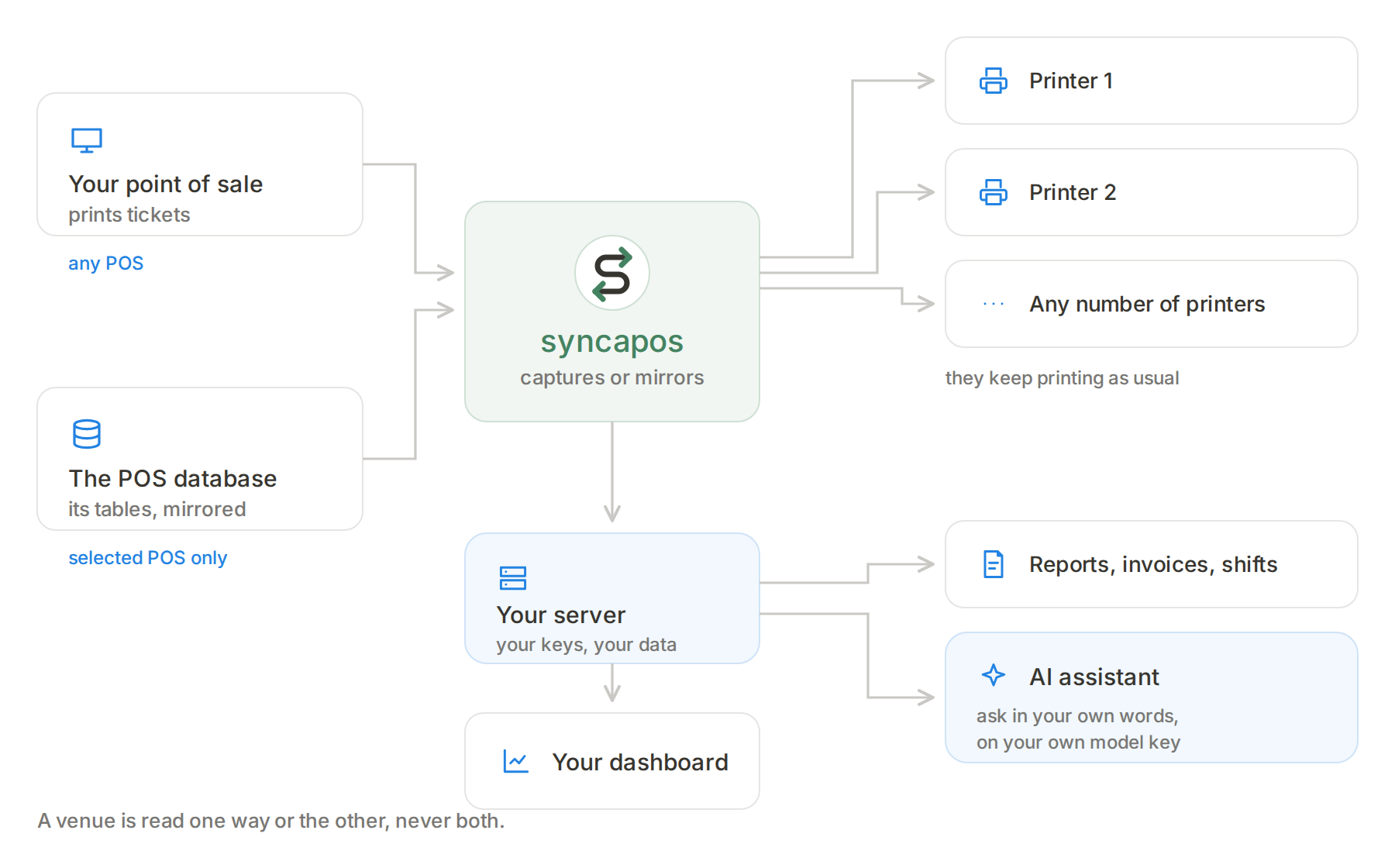
Paper. An agent on the till’s computer sits between the point of sale and its printer, copies every ticket and sends it to the server. The till prints as it always did; nobody touches the POS and nobody asks the vendor for anything. A model reads the ticket and turns it into a sale.
Database. The same agent reads the point of sale’s own database and mirrors its tables onto the server. That way what never printed comes in too: cancellations, reopened tables, discounts applied afterwards.
A venue uses one or the other, never both, or the same sale lands in the books twice.
What a ticket does not say
Most of the work here is in the distinctions a ticket leaves out:
- a bill printed three times is one sale, not three;
- the folio restarts every morning, so on its own it identifies nothing;
- a restaurant’s day begins when it opens, not at midnight: a 03:30 ticket belongs to the evening that opened at 17:00;
- the kitchen copy is not a sale, and neither is the Z report.
Points of sale
Tested against real installations: SoftRestaurant 8, 9, 10 and 11.
Adding another one takes no programming: you write down in the catalogue what that till prints and what columns its database holds. What we cannot say is that it works, because we have no such till to try it on.
What you need
- a machine with Docker (the server, the database and the assistant come in the same stack);
- your own key from a model provider, to read the tickets;
- the agent on every till you want to read.